

25 Aug 2026

.png)
Many businesses grow through individual effort rather than a dependable process.
The founder brings customers through personal relationships. Enquiries are managed through memory or WhatsApp. Marketing happens when sales become slow. Follow-up depends on who remembers. Customer feedback is collected occasionally. The team remains busy, but nobody can clearly explain where growth is coming from.
This can work for a while.
However, as the business becomes busier, the same informal approach creates missed leads, inconsistent service, founder dependency, and unpredictable revenue.
A business growth system is the connected process through which a business attracts the right customers, builds trust, converts enquiries, delivers value, encourages repeat business, and learns from its results.
It turns growth from a collection of isolated activities into a repeatable operating process.
A growth system does not remove the need for people, judgement, or creativity. It gives those efforts a clear direction.
A business growth system is a structured and measurable process that connects customer acquisition, sales, delivery, retention, and improvement.
It answers questions such as:
A strong system creates a clear path from customer attention to long-term business value.
The system does not need to be complicated.
For a small business, it may begin with:
The value comes from connecting these elements and using them consistently.
A business may have a successful month because of a referral, festival period, large order, viral post, or founder relationship.
But if the business cannot explain why the result happened, it cannot reliably repeat it.
A growth system helps the owner identify:
This creates learning, not just activity.
In many owner-led businesses, the founder is responsible for marketing, sales, approvals, problem-solving, customer relationships, and follow-up.
Customers may trust only the founder. Team members wait for decisions. Important information remains inside the founder’s phone or memory.
A growth system documents the process and creates accountability.
The founder may still remain involved in important decisions, but every routine action no longer needs personal intervention.
Generating enquiries is only one part of growth.
A business can lose leads because:
A growth system defines what happens after attention is created.
Without a system, marketing is often measured through posts, clicks, reach, followers, or lead volume.
A connected growth system tracks what happens after the enquiry:
This allows marketing decisions to be based on commercial outcomes.
A funnel may describe how people move from awareness to purchase.
A growth system also includes delivery, retention, reviews, referrals, team responsibilities, and measurement.
Customer relationship management software can help record leads and communication.
But software cannot repair an unclear offer, poor customer experience, or missing follow-up discipline.
Automation can make repetitive work faster, but automating a weak process creates faster confusion.
The process must be clear before it is automated.
A plan can define direction.
A system determines what happens repeatedly, who is responsible, how performance is measured, and how the process improves.
Customers still value personal attention, judgement, empathy, and trust.
The system should support better human interaction, not make the business feel mechanical.
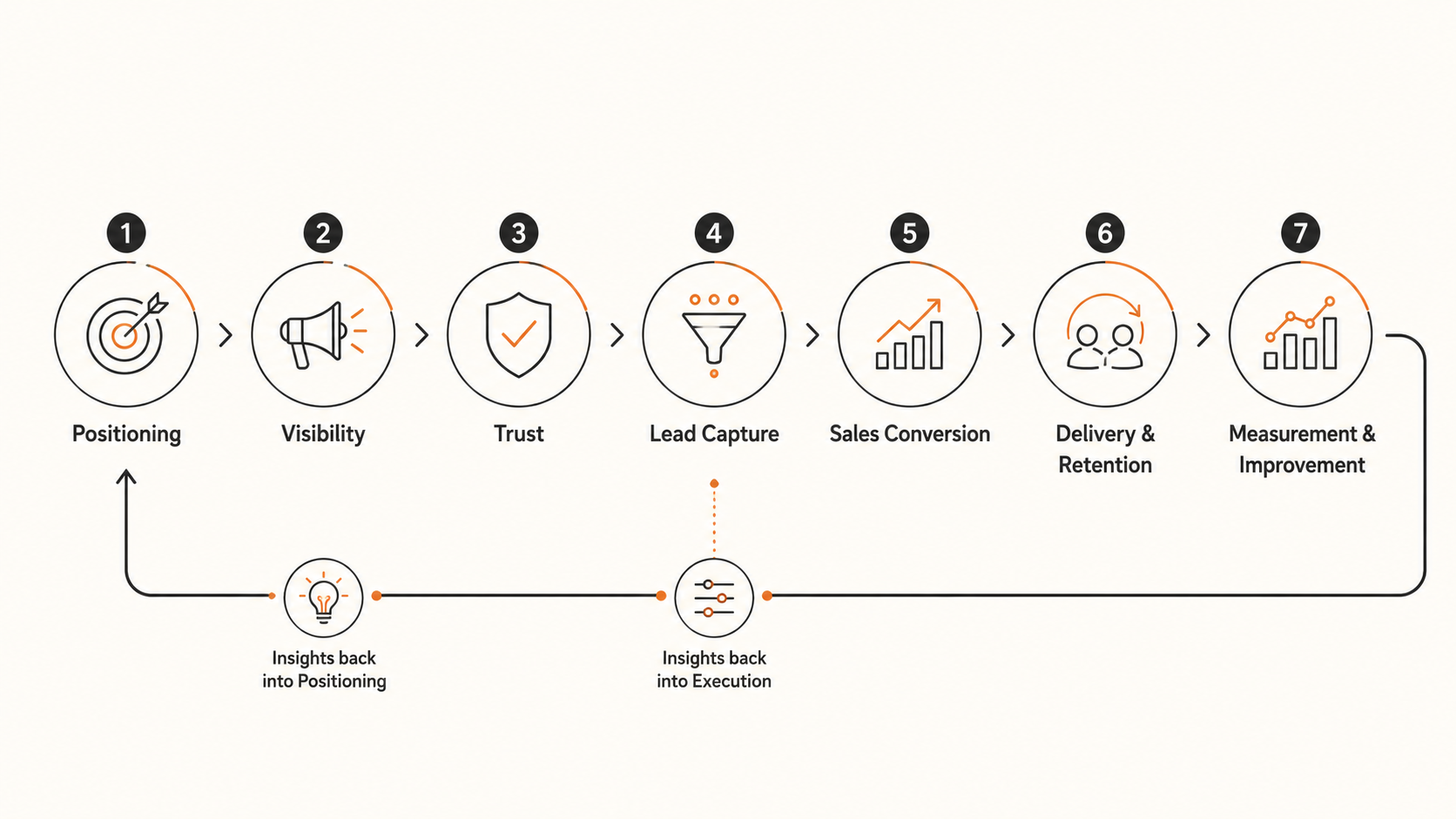
A practical business growth system can be organised into seven connected stages.
Positioning defines who the business serves, which problem it solves, and why the customer should choose it.
Without clear positioning, the business attracts mixed enquiries and struggles to communicate value.
Your positioning should clarify:
Positioning gives the entire growth system direction.
Visibility helps suitable customers discover the business.
Depending on the business, this may include:
The objective is not to be visible everywhere.
It is to be present where the customer searches, evaluates, and asks for recommendations.
Customers may notice a business without being ready to enquire.
Trust helps them reduce uncertainty.
Useful trust signals include:
Trust should be built before the business asks for a major commitment.
Once a customer shows interest, the business needs a structured response.
The system should record:
Each lead should have a clear owner and next action.
A simple spreadsheet may be enough at the beginning. The important part is consistent use.
Sales conversion is the process of helping a suitable customer make a confident decision.
This may include:
A sales process should not pressure every lead.
It should help the business identify the right customers and guide them through a clear decision.
Growth does not end when the sale is completed.
The customer experience affects:
A retention process may include:
A business that retains customers does not need to replace its entire customer base every month.
The system should produce information that helps the business improve.
Useful measures may include:
Do not track every number simply because it is available.
Track the numbers that help the team make better decisions.
Write down what currently happens from the moment a customer discovers the business until after the sale.
For example:
This simple map reveals missing steps.
Do not try to fix everything at once.
Ask where the biggest loss is happening.
Examples:
Fixing the weakest stage often creates more value than adding another marketing channel.
Create a basic process for:
Keep the first version simple.
Every process needs an owner.
Avoid responsibilities such as:
The team will follow up.
Instead, define:
The front-desk executive records every enquiry and sets the next follow-up before the end of the day.
Clear ownership improves accountability.
Tools may include:
Choose tools based on the process and team capability.
Do not purchase complex software before the team understands the workflow.
A weekly review may examine:
A monthly review may examine:
A system becomes valuable when the business uses the information to act.
A clinic growth system may include:
The system connects marketing with the actual patient experience.
A restaurant may build a system using:
Posting content is only one part of the system.
A manufacturer’s system may include:
Because the sales cycle is longer, disciplined tracking becomes especially important.
A consultant may use:
The system turns founder knowledge into a repeatable business process.
A weak follow-up process will waste a larger number of leads.
Tools should support a clear workflow, not replace one.
A dashboard does not improve the business unless someone uses it to make decisions.
A single platform can change, become expensive, or stop performing.
Build a balanced set of relevant customer-acquisition channels.
Growth becomes expensive when the business focuses only on new customers and forgets retention, referrals, and repeat purchases.
A small team may not maintain a system with too many fields, reports, and approval steps.
Begin with the minimum process the team can follow consistently.
A system cannot reduce founder dependency if every step still requires founder approval.
Define which decisions the team can make independently.
Document the existing journey from customer discovery to repeat purchase.
Choose the weakest stage and create a basic process for it.
Define ownership, response times, follow-up rules, and tracking responsibilities.
Measure the first results, identify gaps, and improve the process.
Do not wait until the entire business is perfectly organised.
Build one reliable process, use it, and improve it.
A business growth system is a repeatable process that helps a company attract customers, convert enquiries, deliver value, retain customers, and improve results.
No.
A sales funnel generally focuses on the journey towards a purchase. A growth system also includes positioning, customer delivery, retention, reviews, referrals, team ownership, and performance measurement.
Not always at the beginning.
A spreadsheet or WhatsApp Business labels may be enough for a small number of enquiries. A CRM becomes useful when lead volume, team size, and follow-up complexity increase.
Begin with the stage where the business is losing the most value.
For one business, this may be visibility. For another, it may be lead follow-up, sales conversion, customer delivery, or retention.
Yes, once the underlying process is clear.
AI and automation can support content creation, reminders, customer responses, reporting, and routine follow-up. They should not replace business judgement or human accountability.
A basic system can be created within a few weeks. A mature system develops over time as the business collects data, improves processes, trains the team, and adopts suitable tools.
A business growth system connects the activities that are often managed separately.
It connects positioning with visibility, visibility with trust, trust with enquiries, enquiries with sales, sales with delivery, and delivery with retention.
The purpose is not to make the business rigid.
The purpose is to make good execution repeatable.
Start by mapping the current customer journey. Identify the weakest stage. Create a simple process. Assign ownership. Track the right numbers. Review the results and improve.
Visibility creates attention. Trust creates leads. Systems create scale. Execution creates results.
A growth system brings these principles together and turns them into the way the business operates.
.png)
.png)