

25 Aug 2026

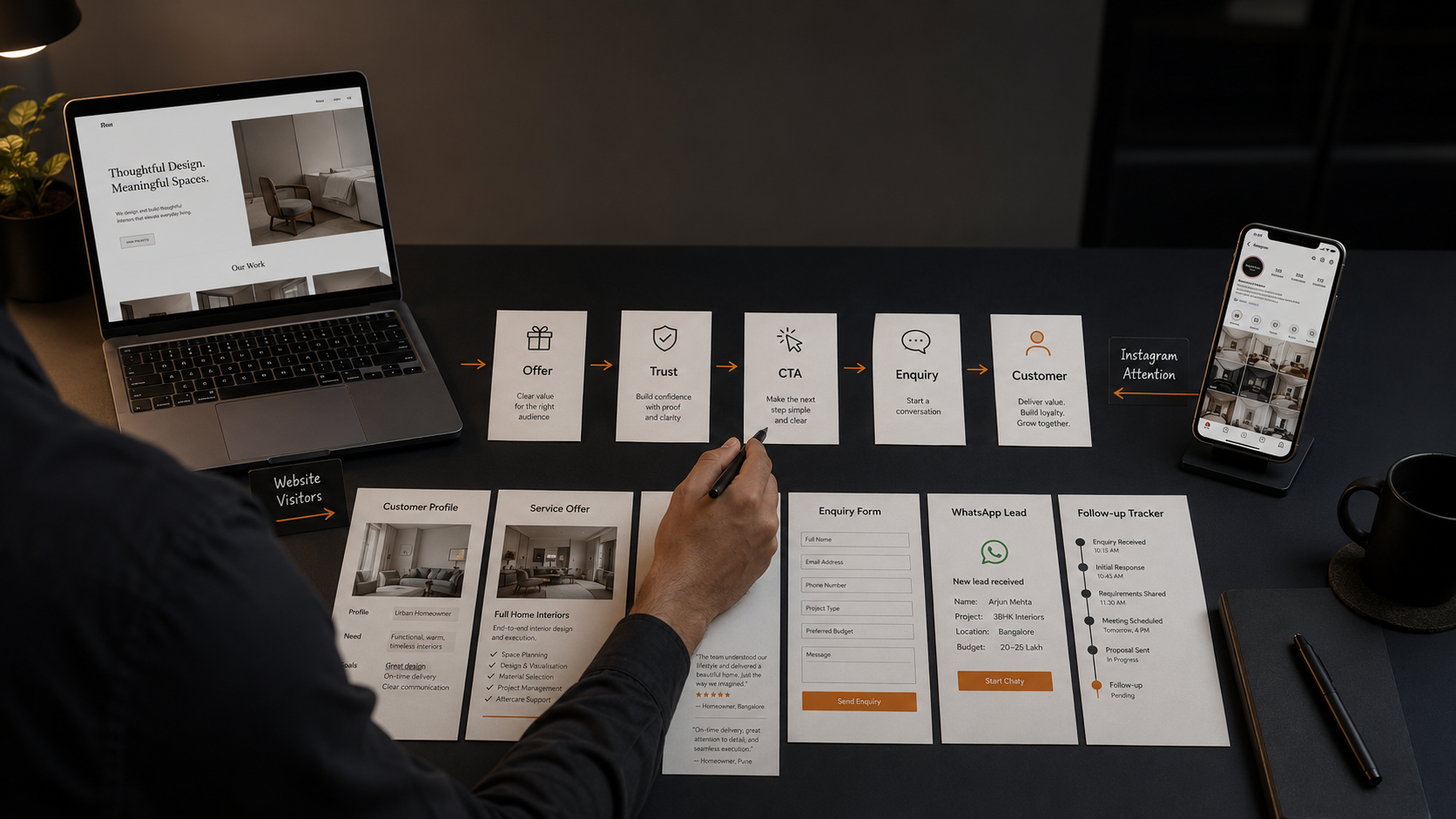
A business may receive thousands of content views, regular website visits, and a growing number of Instagram followers without receiving enough enquiries.
This can feel confusing.
The founder sees attention but not business results.
They may respond by posting more frequently, changing the website design, running advertisements, or trying to increase follower numbers.
But more attention does not automatically create more customers.
A website visitor or Instagram follower may still be unclear about:
To turn website visitors into customers, the business needs a clear conversion path.
This path should move the right person through four important decisions:
Conversion is not created by one button or one promotional post.
It is the result of clear positioning, relevant content, credible proof, suitable offers, low-friction actions, and consistent follow-up.
Someone may view a post because it is entertaining, educational, or visually attractive.
That does not mean they currently need the offer.
Similarly, a website visitor may be:
The objective is not to convert every visitor.
It is to help suitable people recognise the next relevant step.
A person may visit the website or Instagram profile but still not understand:
A confusing profile cannot be repaired simply by increasing reach.
Educational content can build attention and trust.
But when every post ends without a relevant action, the audience may remain passive.
The person learns from the business but never understands:
The offer may be clear, but the customer may still need:
Trust often develops across several touchpoints.
A new visitor may not be ready to:
A smaller and clearer first step can reduce hesitation.
Not every page visitor has the same level of readiness.
This person is learning about a problem.
They may need:
This person is comparing approaches or providers.
They may need:
This person is ready to act.
They may need:
A strong website supports all three levels but gives each visitor a clear path.
Do not force every person towards the same action.

Use seven connected elements to turn attention into customer action.
The traffic or followers must include people who may genuinely need the offer.
Ask:
A large irrelevant audience may create engagement without commercial value.
The quality of attention matters.
A visitor should quickly understand:
Review the website hero section and Instagram bio.
Avoid vague messages such as:
Helping businesses achieve their potential.
A clearer message may be:
We help owner-led businesses improve positioning, lead follow-up, sales systems, and team accountability.
The person should not need to study several posts before understanding the business.
Attention converts when the customer sees a useful and specific offer.
A broad service list can create confusion.
Instead of presenting:
Create focused entry offers such as:
The first offer gives customers a clear way to begin.
The customer needs evidence that the business can deliver.
Trust signals may include:
Do not place all proof on one page.
Add relevant proof near the offer and CTA.
Never invent results, client names, testimonials, or achievements.
Use:
[ADD VERIFIED EXAMPLE]
or
[VERIFY BEFORE PUBLISHING]
where evidence is required.
Every important page, profile, or content series should guide the customer towards a suitable next step.
Possible actions include:
Avoid using only:
Contact us.
Explain what the customer is contacting you for.
For example:
Request a Clinic Visibility Assessment
or:
Get a Quotation for Your Custom Furniture Project
Specific CTAs feel more relevant.
When someone takes action, the business should record and guide the enquiry.
Capture information such as:
Then follow up consistently.
Website and Instagram conversion cannot be measured only through clicks.
The business must know what happens after the click.
Track the full journey.
Useful measurements include:
Do not improve only the content with the lowest engagement.
Improve the stage where suitable customers stop progressing.
The first section should explain:
Avoid beginning only with a company slogan.
Each important service should have a page covering:
Do not expect one home page to explain every service properly.
A person clicking an advertisement for clinic marketing should not land on a general agency home page.
Send them to a relevant page that continues the same message.
The customer should feel:
This is what I expected to see.
Add testimonials, project examples, qualifications, or process details near:
Customers need reassurance at the point of decision.
Do not request unnecessary information too early.
Ask only what is required for the next step.
A consultation form may initially need:
Detailed information can be collected later.
Many visitors arrive through phones.
Check:
A difficult mobile experience silently reduces conversion.
After the person enquires, show:
Do not leave the customer uncertain about whether the message was received.
The Instagram profile should explain:
A visitor should understand the business before exploring individual posts.
Use a balanced content system.
Helps the audience recognise an issue.
Example:
Five reasons local businesses receive enquiries but fail to convert them.
Explains how to approach the issue.
Example:
A simple lead-follow-up process for small teams.
Shows process, founder thinking, customer proof, team, or behind-the-scenes work.
Explains:
Answers concerns about price, timeline, suitability, process, or expected outcomes.
A profile filled only with educational posts may build an audience without creating enough commercial direction.
The CTA should match the content.
Examples include:
Do not ask for several actions in one post.
Highlights may organise:
Stories can support:
Keep important information accessible beyond a 24-hour story.
The profile link should take the customer towards a relevant next step.
Possible destinations include:
Avoid sending everyone to a complicated page with too many unrelated links.
Instagram direct messages may begin the conversation, but qualified enquiries should be recorded.
Move the customer into:
Do not allow commercial opportunities to remain buried inside social-media messages.
A clinic’s Instagram may educate customers but produce few appointments.
Improve the conversion path through:
Medical claims and patient communication must be reviewed appropriately.
[VERIFY BEFORE PUBLISHING]
Instagram followers may admire completed projects but not enquire.
Add content explaining:
Use a CTA such as:
Send your location and project type to request an initial consultation.
A manufacturer’s website may receive traffic but few quotation requests.
Improve the site through:
The CTA should match the B2B buying process.
A consultant may have many followers but unclear services.
Create a direct path:
The offer creates a commercial starting point.
A restaurant can connect content to action through:
Food photographs attract attention, but practical information helps create visits and orders.
A large audience does not guarantee commercial fit.
Different content and pages serve different levels of customer readiness.
Customers should not need to search through months of posts to understand what the business sells.
Use relevant service, booking, product, or landing pages.
Reduce unnecessary form fields and steps.
Engagement does not become revenue automatically.
A delayed or generic response can lose genuine interest.
Track qualified enquiries and customer outcomes.
Some customers need education, comparison, proof, and follow-up before acting.
Day 1: Review the website hero section and Instagram bio.
Day 2: Define one primary customer and one entry offer.
Day 3: Add relevant proof near the offer.
Day 4: Improve one important CTA and its destination page.
Day 5: Create content for problem, trust, offer, and objection stages.
Day 6: Test forms, WhatsApp links, profile links, and mobile usability.
Day 7: Create a tracker connecting visits and messages to qualified enquiries and sales.
Do not begin by asking how to get more followers.
First ask whether the current customer has a clear path from attention to action.
Common reasons include irrelevant traffic, unclear messaging, weak trust, confusing offers, poor mobile experience, difficult forms, and no clear next step.
There is no universal conversion rate.
Performance depends on traffic source, customer intent, price, business model, offer, trust, and buying cycle.
Measure improvement within your own customer journey.
Some followers may become customers when the profile, content, offer, and CTA are relevant.
Many followers may never buy, particularly when they followed for general information or entertainment.
No.
Use a balanced system of education, trust, proof, objection handling, and offer communication.
The audience should understand what the business sells without every post becoming promotional.
WhatsApp may be useful when customers prefer conversation and the business has a structured response process.
Complex offers may require a service page or qualification form before the WhatsApp conversation.
Track profile visits, link clicks, direct messages, WhatsApp enquiries, forms, qualified leads, appointments, quotations, and sales.
Ask customers how they discovered the business.
To turn website visitors into customers, a business needs more than traffic, followers, and content.
It needs a connected conversion system:
A website should not only provide information.
Instagram should not only create engagement.
Both should help suitable customers move towards a practical next step.
Visibility creates attention. Trust creates leads. A clear conversion path creates customer action. Systems create scale. Execution creates results.
.png)
.png)