

25 Aug 2026


Customers rarely buy based on the offer alone.
Before they book an appointment, send an enquiry, approve a quotation, or make a payment, they are trying to reduce uncertainty.
They may be asking:
These questions become more important when the business is new, the price is high, the service is complex, the buying cycle is long, or the outcome is difficult to evaluate in advance.
Learning how to build customer trust does not mean using more promotional language.
Trust is built through what the customer can see, understand, verify, and experience.
A business earns trust when it communicates clearly, makes responsible promises, presents genuine proof, responds professionally, and delivers consistently.
The sale should not be the first moment when the business asks the customer to take a risk.
Before asking for commitment, give the customer enough information to make a confident decision.
Many products and services are difficult to judge before purchase.
A customer cannot know with complete certainty:
Because complete certainty is impossible, customers look for trust signals.
These signals help them decide whether the business appears competent, honest, organised, and accountable.
A lower-priced option may still feel expensive if the customer believes the risk is high.
A customer may choose a higher-priced provider because:
Trust changes how customers interpret price.
When customers understand and trust the business before contacting it, conversations become more productive.
They are more likely to arrive with:
Trust does not only increase enquiries. It can improve the quality of those enquiries.
Customers may not use the word “trust,” but they are evaluating several areas.
Can the business perform the work?
Customers look for experience, qualifications, product knowledge, technical information, samples, and clear processes.
Will the business do what it says?
Customers notice response times, consistency, punctuality, follow-up, and whether information remains accurate.
Is the business honest about pricing, limitations, timelines, and expected outcomes?
Overpromising can create attention but weaken confidence.
Does the business understand this customer’s specific situation?
General experience may be less persuasive than clear understanding of the customer’s problem.
Will someone take responsibility if the customer has a question or something goes wrong?
Clear contact ownership and support terms reduce uncertainty.
What protects the customer from making the wrong decision?
Samples, pilots, written scope, approvals, milestones, and transparent policies can reduce perceived risk.
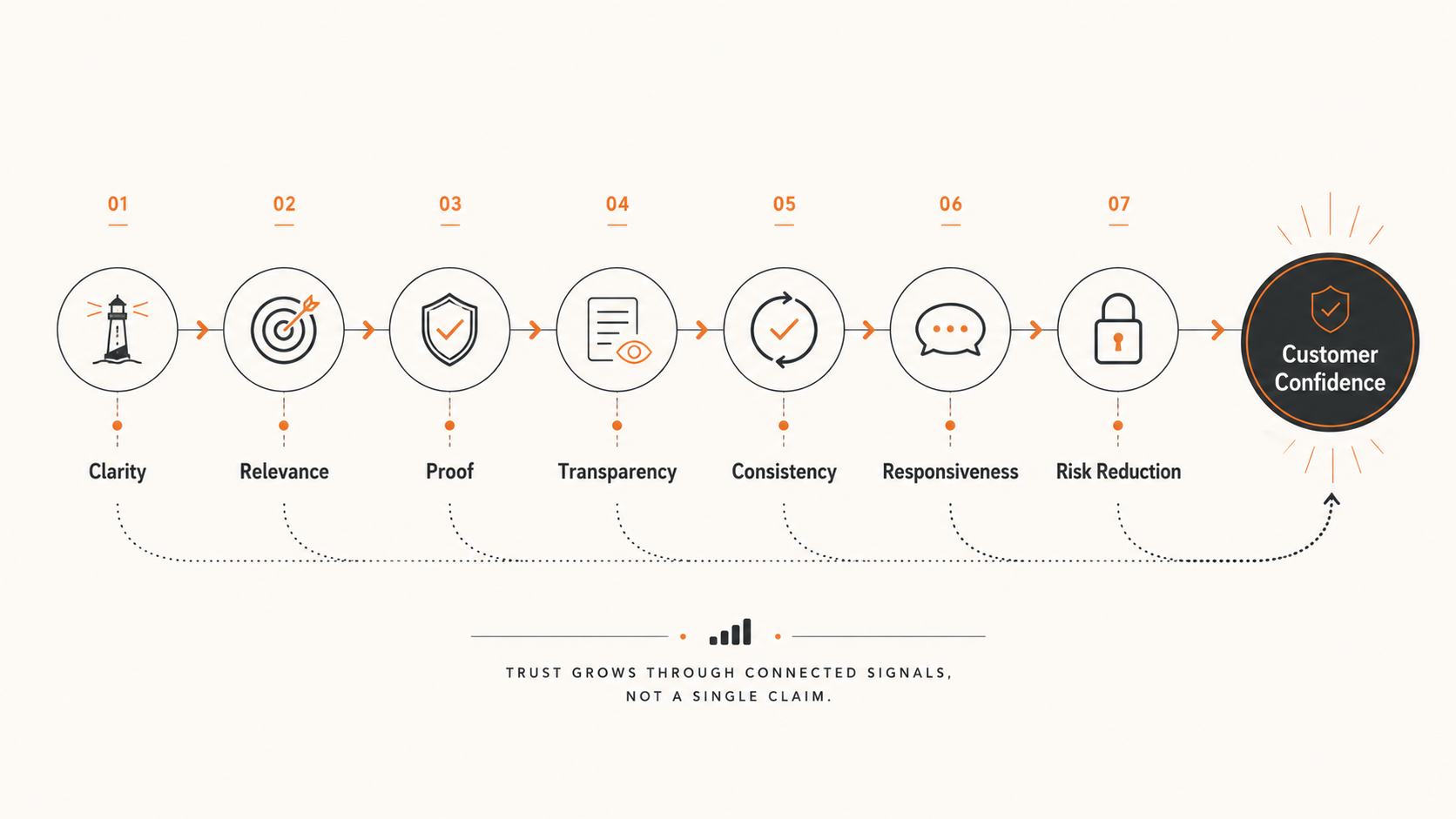
Use seven connected factors to build trust before asking for a sale.
Customers trust businesses they can understand.
Clearly explain:
Confusion creates hesitation.
Avoid forcing customers to interpret broad terms such as:
Use specific language connected to the customer’s situation.
Customers want to know whether the business understands their type of requirement.
Relevance may be demonstrated through:
For example, a manufacturer evaluating a marketing partner may want more than social media content. It may need technical positioning, product pages, distributor communication, and a structured B2B enquiry process.
The business builds trust by showing that it understands these priorities.
Customers need evidence that supports the promise.
Proof may include:
Use proof close to the claim it supports.
A generic testimonial may be less useful than a specific review describing communication, delivery, quality, or customer experience.
Never invent customer names, outcomes, revenue figures, awards, or achievements.
Use:
[ADD VERIFIED EXAMPLE]
or
[VERIFY BEFORE PUBLISHING]
where evidence is required.
Customers trust businesses that explain what will happen.
Transparency includes:
Transparency does not require publishing every internal detail.
It means avoiding surprises that could reasonably have been explained before the sale.
A clear limitation can build more trust than an unrealistic promise.
Trust develops when customers receive the same reliable message and experience across touchpoints.
Review consistency across:
If the website promises a response within one hour but nobody replies for two days, the inconsistency weakens trust.
The brand promise and operational reality must match.
How the business responds is part of how it is judged.
Customers notice:
Fast responses are useful, but accuracy and professionalism also matter.
Do not automate every conversation without considering the customer’s situation.
A helpful response builds more trust than an immediate but irrelevant message.
The customer may need a safe way to begin.
Risk-reduction options include:
Risk reduction should not mean providing significant work free of charge.
It means creating an appropriate first commitment based on the customer’s current level of trust.
Trust should be present at every stage, not added only near the payment button.
The customer first finds the business through Google, social media, a referral, an advertisement, an event, or direct outreach.
At this stage, trust is influenced by:
The goal is not to make the customer buy immediately.
It is to make the business worth exploring.
The customer wants to understand whether the business is suitable.
Provide:
Avoid hiding basic information to force the customer into a sales call.
A sales conversation should add value, not merely reveal information that could have been communicated clearly.
Make the enquiry process simple.
Customers should know:
Test:
Broken or unanswered contact points immediately weaken trust.
The sales conversation should help both sides assess fit.
Ask questions before presenting the complete offer.
Understand:
Do not pressure customers who are not suitable.
A business also builds trust by saying when its offer is not the right fit.
A professional proposal should clarify:
Avoid adding complexity simply to make the proposal look substantial.
Clarity is more useful than length.
Trust must continue after payment.
Confirm:
The period immediately after payment is important. Silence can create doubt.
Deliver what was promised.
Provide updates when appropriate. Record approvals. Explain delays honestly. Ask for feedback. Address problems professionally.
Trust built before the sale is either strengthened or damaged by delivery.
A clinic can build trust before an appointment by showing:
It should avoid guaranteed medical outcomes or unverified treatment claims.
All healthcare content should be reviewed by an appropriately qualified professional before publication.
[VERIFY BEFORE PUBLISHING]
Customers may worry about material quality, timelines, changing costs, and installation.
The business can reduce uncertainty through:
The process becomes part of the trust signal.
A B2B buyer may evaluate:
Trust can be built through technical documentation, factory photographs, certification, sample approval, and structured quotation communication.
All capability and certification claims should be verified.
A consultant can build trust by presenting:
The consultant should avoid claiming guaranteed revenue growth when the result depends on customer implementation and market conditions.
An ecommerce business can reduce buyer uncertainty through:
The product page should answer the questions customers usually ask before ordering.
Trust cannot be created through a claim alone.
Show customers the process and proof.
False countdowns, invented stock limits, and repeated “last chance” messages may create pressure but weaken long-term credibility.
Some customised services require assessment before final pricing.
Even then, explain pricing factors, starting points, or the quotation process where appropriate.
Testimonials should be genuine, approved, and accurately represented.
Do not guarantee outcomes influenced by customer behaviour, competition, market conditions, or other external factors.
Respond professionally and avoid arguing publicly.
Use repeated feedback to improve the business.
Automation can improve response and consistency, but customers should have access to a responsible person when the situation requires judgement.
A high-price or complex service may need a diagnostic, pilot, sample, or consultation before a larger engagement.
Day 1: List the main concerns customers have before buying.
Day 2: Review your website, Google profile, social media, and proposal from a new customer’s perspective.
Day 3: Collect and organise verified proof.
Day 4: Clarify pricing, scope, process, exclusions, and customer responsibilities.
Day 5: Test every enquiry and booking method.
Day 6: Create a suitable low-risk first step.
Day 7: Train the team to communicate and follow up consistently.
Do not begin by asking how to persuade customers more strongly.
Begin by asking what they need to understand and verify before feeling confident.
Use founder experience, qualifications, samples, prototypes, demonstrations, transparent processes, clear scope, and a smaller paid pilot.
Do not create fake customer proof.
Trust can begin during the first interaction, but it strengthens through repeated consistency.
The time required depends on the price, risk, complexity, and importance of the purchase.
Follower numbers may create visibility, but they do not automatically prove competence or reliability.
Relevant content, genuine engagement, customer proof, and professional communication are stronger signals.
Clear pricing can reduce uncertainty when the offer is standardised.
For customised work, explain the pricing method, starting point, or assessment process where appropriate.
Discounts may encourage action, but they do not create trust by themselves.
Clarity, proof, transparency, and reliable delivery are more important.
There is no single strongest signal for every business.
Customers usually evaluate a combination of relevant proof, clear communication, consistent experience, professional responsiveness, and low buying risk.
Learning how to build customer trust is not about making the business sound more impressive.
It is about reducing uncertainty through:
Show customers whom you help and what you provide. Present genuine evidence. Explain the process. Make responsible promises. Respond properly. Give the customer a suitable way to begin.
Trust is not created in one website section.
It develops across every interaction—from the first search result to the sales conversation, payment, delivery, and follow-up.
Visibility creates attention. Trust creates leads. Systems create scale. Execution creates results.
Before asking for the sale, make sure the customer has enough reason to believe the business can deliver what it promises.
.png)
.png)