
25 Aug 2026

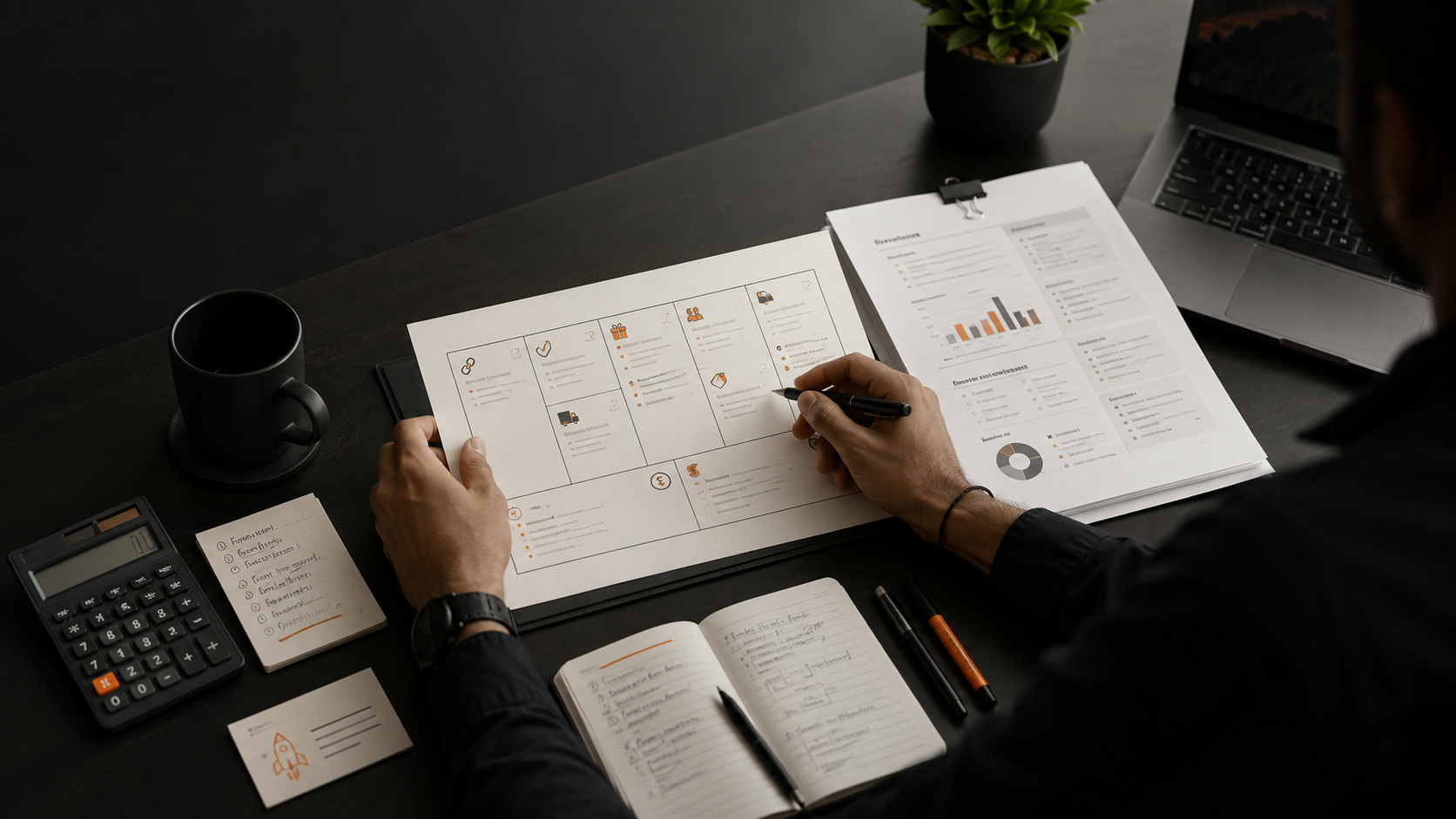
Many first-time founders believe they need to begin with a detailed business plan.
They open a document and start writing about the company vision, market size, team structure, projected revenue, marketing strategy, and future expansion.
The document may look professional, but one important question often remains unanswered:
How will this business actually work?
This is where understanding business model vs business plan becomes important.
A business model explains how a business creates value for customers, delivers that value, and earns money from it.
A business plan is a more detailed document explaining how the founder intends to launch, operate, finance, and grow the business.
Both are useful. But they serve different purposes.
For most early-stage founders, the business model should come first. It helps clarify the customer, problem, offer, revenue, costs, delivery, and customer-acquisition process before those assumptions are turned into a formal plan.
A detailed plan built on an unclear model is simply a well-formatted collection of assumptions.
A business model explains how the business will operate commercially.
It answers questions such as:
The business model is not limited to pricing.
It connects the customer, offer, delivery, revenue, costs, and growth process.
For example, two restaurants may sell similar food but operate with different business models.
One may depend on premium dine-in experiences and reservations. Another may focus on delivery, a limited menu, fast preparation, and repeat office orders.
They operate in the same industry, but the way they create and earn value is different.
A business plan is a structured document describing the business, its objectives, market, operations, financial expectations, and growth approach.
A detailed plan may include:
A business plan can help founders organise their thinking and communicate the opportunity to other people.
It may be useful when speaking with:
However, a business plan should not be treated as proof that the business will succeed.
It is a plan based on assumptions. Those assumptions still need to be tested in the market.

The simplest distinction is:
A business model explains how the business works. A business plan explains how you intend to build and operate it.
A business model is usually:
A business plan is usually:
The model is the foundation.
The plan expands the foundation into a structured operating and growth document.
For most founders, the business model should come first.
Before writing a lengthy plan, you need reasonable answers to these questions:
If these questions remain unclear, detailed revenue projections and expansion plans may create false confidence.
A better sequence is:
This approach keeps the founder focused on business reality rather than document completion.
A practical early-stage model can be built using six connected areas.
Who is the business designed to serve?
Avoid beginning with “everyone.”
Define the first suitable customer using factors such as:
For example:
Owner-managed clinics in Pune that receive patient enquiries through Google and WhatsApp but lack a structured follow-up process.
A specific customer definition improves research, positioning, marketing, and sales.
What important problem does the business solve?
Then clarify the value created by solving it.
The problem may involve:
The value proposition should explain why the solution matters.
For example:
A follow-up system that helps clinics respond consistently, reduce missed enquiries, and organise appointment communication.
Avoid beginning with features alone. Connect the offer to a practical customer outcome.
What exactly will the customer receive, and how will it be delivered?
The offer may be:
Clarify:
An offer that sells but cannot be delivered consistently is not a strong model.
How will customers discover and choose the business?
Possible channels include:
Do not list every possible channel.
Identify the channels that match how your customer searches, compares, and buys.
Also consider the complete journey:
Customer acquisition includes both marketing and conversion.
How will the business make money?
Possible revenue models include:
Then examine the main costs:
The business needs enough margin to operate, improve, and handle unexpected costs.
What happens after the first purchase?
A business model becomes stronger when customers:
Also ask whether the delivery process can be repeated without depending entirely on the founder.
A sustainable model should gradually support:
Do not begin with a 40-page document.
Create a one-page model answering:
Keep the language simple enough that another person can understand how the business works.
Founders often write assumptions as if they are facts.
For example:
These may be reasonable assumptions, but they still need evidence.
Mark each one as:
This helps you decide what to test first.
Ask customers about their current behaviour.
Useful questions include:
Do not rely only on whether they say the idea sounds good.
Study what they currently do.
Build the smallest version that can deliver meaningful value.
A consultant may offer a paid diagnostic project.
A food business may test a limited menu through preorders.
A manufacturer may create a prototype or sample batch.
A software founder may initially deliver the result manually before building the full platform.
The minimum offer tests the business model without requiring the full business infrastructure.
Estimate the result of serving one customer.
Ask:
Then test whether the model improves when the business serves more customers.
Growth should not multiply an unprofitable process.
Use customer conversations, pilot results, objections, and delivery experience to improve the model.
You may need to change:
Once the basic model has evidence, it becomes easier to write a realistic business plan.
The detailed plan may then cover location, kitchen setup, staffing, licences, operating hours, marketing budget, sales forecasts, and expansion milestones.
The model explains how the restaurant earns. The plan explains how it will be established and managed.
The business plan may later define hiring, service capacity, financial targets, partnerships, and new products.
The business plan would add supplier details, inventory requirements, cash-flow projections, team structure, and launch timelines.
The plan may then explain capital investment, capacity, quality systems, hiring, sales targets, and working-capital requirements.
Market reports cannot replace direct customer conversations.
Research the real buying problem before finalising the plan.
A spreadsheet can calculate future revenue, but it cannot prove that customers will purchase.
Projections should be based on transparent assumptions and updated as evidence develops.
A strong product still needs a reliable way to reach, convince, and convert customers.
Include acquisition and sales in the model.
Founders often calculate materials but forget labour, support, returns, travel, revisions, commissions, and their own time.
Include the complete delivery cost.
A template can organise information, but it cannot make strategic decisions for the founder.
Use the sections that are relevant to the business and intended reader.
A plan should change when customer evidence, costs, regulations, capabilities, or market conditions change.
Updating the plan is responsible management, not a sign of failure.
A new founder may spend weeks creating a large document nobody uses.
Begin with a one-page model. Add detail when the business or stakeholder requires it.
Day 1: Define one specific customer and problem.
Day 2: Write a clear offer and desired customer outcome.
Day 3: Identify how the business will acquire and convert customers.
Day 4: Estimate revenue, delivery costs, and basic margins.
Day 5: Define how customers may repeat, renew, or refer.
Day 6: Mark the assumptions that have not been tested.
Day 7: Select one assumption and test it through customer conversations or a minimum offer.
Do not try to complete a perfect formal document in seven days.
Create a model that is clear enough to test.
A business model explains how the company creates value, delivers it, reaches customers, and earns money.
A business plan is a detailed document describing how the company will launch, operate, finance, and grow.
You may not need a lengthy formal plan before testing a simple idea.
However, you should understand the customer, offer, revenue, costs, delivery, and acquisition process. A formal plan becomes more important when significant investment, borrowing, partnerships, or operational complexity is involved.
There is no universal length.
The document should contain enough relevant information for its purpose and intended reader. A small internal plan may be concise, while an investor, lender, or expansion plan may require greater detail.
Yes.
Customer feedback, costs, competition, technology, and delivery experience may reveal that the model needs to change. Strong founders update the model based on evidence.
No.
A pitch deck is a shorter visual presentation used to communicate an opportunity. A business plan provides greater detail about the market, operations, strategy, risks, and financial assumptions.
The model should include basic revenue, pricing, costs, margins, and payment assumptions.
Detailed forecasts, cash-flow planning, and funding requirements are usually developed more fully in the business plan.
Understanding business model vs business plan helps founders work in the correct sequence.
The business model explains:
The business plan turns this commercial logic into a detailed execution document.
Begin with the model. Test the important assumptions. Learn from real customers. Improve the economics. Then write the plan required for execution, funding, partnerships, or team alignment.
A good plan can guide the business.
But it becomes far more useful when it is built on a model that has faced the market.
.png)
.png)